Sunday, 27 April 2014

Ancestor #13 – Christopher Edinborough


Crossing the Atlantic to America, Ancestor #13 enlisted with the Union Army in the US Civil War.

As a 21-year-old, Christopher Edinborough enlisted at Scio, New York on 13 May 1861 for a term of three years and was mustered to the 65th New York Infantry Regiment. A physical description of Christopher is gleaned from his regimental Company Descriptive Book which states that he was 5 feet 5 inches tall, of dark complexion with brown eyes and black hair. Born in London, England, his occupation was given as shoemaker.

Initially mustered into C Company as a Corporal, Christopher was promoted to Sergeant on 15 Nov 1862 before being returned to ranks as a Private on 1 Feb 1863. On 15 April 1863 he was promoted back to Corporal.

A document recently found on Ancestry.com entitled New York, Town Clerks’ Registers of Men Who Served in the Civil War, ca 1861-1865 revealed three other male Edinboroughs also signed up. They were: Charles (enlisted 12 May 1861), Fergus (3 Apr 1865) and Luther (3 Apr 1865). The document was a good find as the four enlistees were in fact brothers, sons of Christopher and Sarah Edinborough, confirming they had emigrated from England as a family in 1855.

Returning to Christopher (of the 65th NY Regiment), while so far I haven’t located a marriage record for him I do know that he married an American woman named Carrie and presumably this was after his discharge from the 65th NY Regiment. The US Census reveals that by 1880 they were living at Wilton in Iowa with two children: a son, Arthur W (7yrs), and a daughter Jesse M (5yrs).

Christopher died in 1892 and is buried at Grand Junction Cemetery, Greene County, Iowa. Carrie survived her husband for a further 31 years and was buried at Grand Junction Cemetery in 1923.


Thursday, 17 April 2014

Ancestor #12 – Edith Edenborough

Edith Edenborough was the second daughter, and fifth child, of Henry (Ancestor #4) and Margaret Edenborough (née Stedman) and was born 28 December 1846 at Wollogorang, New South Wales, Australia.

In 1854 she travelled to the United Kingdom when her parents returned to England with their six children after selling their large pastoral property, Wollogorang, to John Chisholm. The first census to be held upon Edith’s arrival in England was that of 1861 where Edith, then aged 14, was living with her widowed mother at Kensington, Middlesex – her father Henry having died one year after his return to England.
 
1861 UK Census
 
In 1870 Edith’s talent as an artist saw her being awarded a silver medal at the South Kensington District Art School where she would also be introduced to Prince Teck, a member of German nobility and father of Queen Mary, the wife of King George V.
 

Edith was twice married: firstly to artist Arthur Murch (in 1873) with whom she lived with in Rome while working with Giovanni Costa – the Italian landscape painter and patriotic revolutionary; then in 1891, as the Widow Murch, she married Matthew Ridley Corbet, another landscape artist of some note. By this time Edith was an acknowledged landscape painter herself, closely associated with the Etruscan group, and who had previously exhibited many works at the Grosvenor and New Galleries of London. Following her marriage to Corbet she exhibited primarily at the Royal Academy, visiting Italy but living in London for the rest of her life.
 
Cicero's Villa and the Bay of Baiae
painted by Edith Corbet in 1909 
 
Edith Corbet (née Edenborough) died in 1920 aged 72.


Wednesday, 26 March 2014

Ancestor #11 – Alan Edenborough

In 1933, the light cruiser HMS Phaeton was meant for the British Royal Navy but was purchased by the Australian government prior to launching. It was renamed as HMAS Sydney (II), in memory of an earlier Sydney (I) that in 1914, had destroyed the German cruiser Emden.

Following her commissioning in 1935, the Sydney spent the early part of her operational history enforcing sanctions during the Abyssinian crisis prior to arriving in Australia in1936.
 

The Sydney then remained on local patrol duties after the outbreak of World War II before being assigned to the British Mediterranean Fleet for an eight-month deployment from April 1940 – during which time she encountered several engagements while receiving minimal damage and no casualties.

Following her return to Australian waters in 1941, her arrival in Fremantle on 5 February received a hero’s welcome. Upon arrival in Sydney, a few days later, her crew received a civic reception and school children were given a public holiday so they could watch her crew parade through the city’s streets.

On Armistice Day, 11 November 1941, the Sydney sailed from Fremantle to escort the troopship Zealandia to Sunda Strait where she was to be relieved by the British cruiser HMS Durban for the last leg of a voyage to Singapore. The voyage was without incident and Sydney was expected to arrive back in Fremantle on the afternoon of 20 November 1941. Having not returned to Fremantle by 23 November the Naval Board requested her to report by signal to which there was no reply.

Piecing together the events of Sydney’s disappearance, it was revealed that on the afternoon of 19 November the Sydney had come upon what was thought to be a merchant vessel but was, in fact, the German raider Kormoran. In an effort to establish the identity of the vessel, the Sydney closed the distance to a point where she no longer had any advantage of her superior armament.

When concealment of the Kormoran’s true identity was no longer possible, the German raider opened fire with all armament as well as dispensing two torpedoes striking the Sydney. In the heat of the battle the Sydney also managed to inflict severe damage to the Kormoran.

The result of the destructive engagement saw all 42 officers and 603 ratings on board the Sydney perish. The crippled Kormoran was eventually skuttled by her captain, with her German crew abandoning ship. Of her 399 crew, 318 were found following a large-scale sea and air search.

Despite the approximate position of Kormoran being known, multiple attempts to locate the two wrecks failed to find either ship until March 2008 when the wrecks of both Sydney and Kormoran were located by shipwreck investigator David Mearns who had directed a search on behalf of the Finding Sydney Foundation.

The discovery of the wrecks revealed much about the battle and lent support to the generally accepted version of events from the surviving German crew members of the Kormoran.

On board HMAS Sydney on that fateful day, was 21-year-old Ordinary Seaman, ALAN GROSVENOR EDENBOROUGH, the son of Grosvenor and Agnes Margaret Edenborough of Roseville, New South Wales and great-grandson of Arthur Edenborough, Ancestor #1.
He is remembered with honour at the Plymouth Naval Cemetery in Devonshire, United Kingdom as well as on the Honour Roll of the Australian War Memorial in Canberra, Australian Capital Territory.
Plymouth Naval Cemetery
 

Friday, 14 March 2014

Ancestor #10 – Alexandra Edenborough

Staying with the famous theme, the British jazz singer Alexandra Edenborough, was born in 1978 in Somerset, England and in 2008, married the British actor, Gary Oldman.

While there is an endless supply of articles and photographs of Alexandra (especially with her husband, Gary Oldman) on the internet, tracking down her parentage for my one name study is proving a little hard.

 
My best guess: that Alexandra is the daughter of Australian-born, Alan Edenborough and his wife, Elizabeth. If correct, Alan is one of the 2xgreat-grandchildren of Ancestor #1 – Arthur Edenborough.

Ancestor #9 – Duke of Edinburgh

When undertaking a one name study you naturally find variations and deviations to your study surname. And in my case, among the 124 variations of the surname Edenborough, is the variation Edinburgh – throwing up another problem: doing on-line searches for the surname Edinburgh resulting in endless records for the city of Edinburgh, SCOTLAND.

Then, of course, there is also the Duke of Edinburgh! So far I haven’t paid a lot of attention to the honorific title, but it does fall into the realm of a one name study.

Named after the city of Edinburgh, Scotland, it is a title that was created in 1726 for the British royal family. To date it has only been used 4 times.

It was first created by George I who bestowed it on his grandson, Prince Frederick, who would later become Prince of Wales. Following Frederick’s death, the title was inherited by Frederick’s son, Prince George, who became George III in 1760. At that time the title, Duke of Edinburgh, ceased to exist.

In 1866, Queen Victoria re-created the title for her second son, Prince Alfred. Alfred’s only son committed suicide in 1899 and, so again, the title Duke of Edinburgh was to become extinct.

Then in 1947 the title was created for a fourth time. King George VI, bestowed it upon his son-in-law, Lieutenant Philip Mountbatten, upon his marriage to the Princess Elizabeth. Until Elizabeth became Queen in 1952, the princess was known as HRH Princess Elizabeth, Duchess of Edinburgh.

Prince Philip, Duke of Edinburgh, is now the longest-serving and oldest-ever spouse of a British monarch. He is also currently the oldest-ever male member of the British royal family.
 
Frederick – Duke of Edinburgh 1
 
 George III – Duke of Edinburgh 2
 Prince Alfred - Duke of Edinburgh 3
 
 Prince Philip – Duke of Edinburgh 4

Sunday, 2 March 2014

Ancestor #8 – Daisy Edenborough

The following newspaper item appeared in The Daily Inter Ocean of 17 November 1888.

 
I am pretty sure that the young Daisy EDENBOROUGH named in the article, is the same Daisy Frances EDENBOROUGH who was born 6 September 1872 in Hagar, Berrien, Michigan, USA
the daughter of F Thomas EDENBOROUGH and his wife Olive Angeline YERINGTON.
 
And while it is not as yet known whether she managed to marry her “rough character”, what is known, is that she was married at least twice: first to George LEAVER in 1892, and then to Edward Colin ALLEN in 1898.

Ancestor #7 – Edward Edinborough

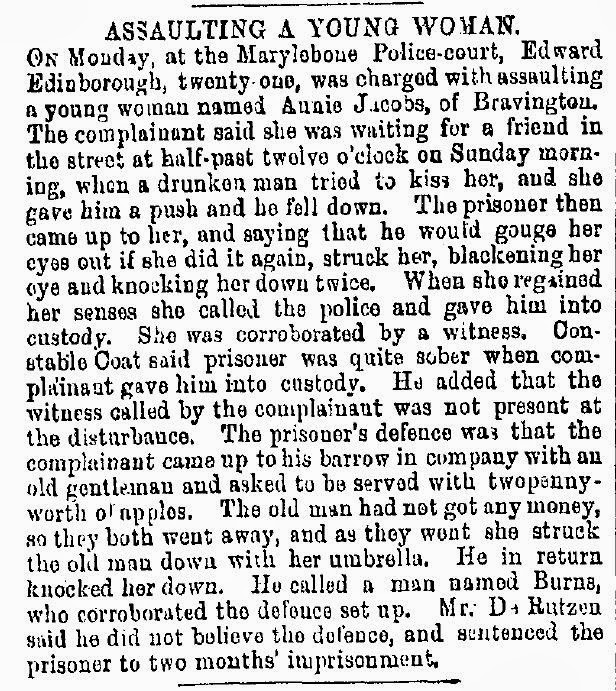
Staying with a criminal theme, the following article titled “assaulting a young woman” appeared in The Illustrated Police News of 7 November 1885: